The Inward Pioneer did not begin with a complete product concept.
It grew out of a difficult period in my own life, along with what our team had learned over several years of building AI companion hardware.
This article explains why we eventually chose Taoism as the core philosophy behind The Inward Pioneer, where its ideas come from, how we turn those ideas into a working AI product, and how we currently judge whether an answer is actually useful.
Some parts of this process are already fairly clear to us. Other parts are still being improved. We want to describe both as honestly as we can.
It started with a period of self-doubt
Before starting this company, I worked as a chief architect for an internet business at one of China's largest smartphone manufacturers.
I led an architecture team and managed several dozen people.
I put a lot of effort into both engineering and management, but for a long time, my relationship with my manager was difficult.
My technical decisions and management methods were frequently questioned. When an online incident happened, even a relatively ordinary problem could turn into heavy criticism.
Over time, I began to doubt my technical ability, my management ability, and eventually my own judgment.
I became increasingly dependent on approval from my manager and my peers.
If other people agreed with me, I felt I had done the right thing.
If they rejected what I did, I immediately started doubting myself.
Eventually this became exhausting.
I would replay conversations in my head, look for everything I might have done wrong, and keep checking my own decisions because of something another person had said.
I was rarely satisfied with my own work.
My mental state became poor, and the stress also started affecting me physically.
Eventually, I left.
After resigning, I began studying the philosophy of Wang Yangming.
I completed Professor Li Bo's course Five Hundred Years of Wang Yangming from Nanjing Normal University, and I also read most of Instructions for Practical Living (Chuanxilu).
The ideas that affected me most were concepts such as “the mind is principle” and “there is nothing outside the mind.”
They made me reconsider a very simple question:
What should a person use to judge whether they are doing the right thing?
For a long time, I had handed that judgment to other people.
If people liked what I did, I thought I was right.
If they rejected it, I assumed I was wrong.
I slowly began trying to bring that judgment back to myself.
I started looking at the facts I understood, my own values, my conscience, and whether I was willing to take responsibility for the consequences of my decisions.
If, after thinking carefully, I believed something was worth doing, I would do it and then continue testing and correcting my judgment through action.
That process gradually helped me move out of a long period of self-doubt and internal conflict.
It also became the starting point for many of the ideas behind our products.
Our first product was a “Wang Yangming friend”
After leaving my previous job, I started a company.
At the time, we were working on AI companion hardware.
I also spent a lot of time talking to general-purpose AI systems. They were powerful. They could provide large amounts of information and answer many kinds of questions.
But when I was dealing with real problems in work, entrepreneurship, or life, I often felt something was missing.
What I wanted felt closer to a person.
If Wang Yangming were alive today, and I told him what I was going through, how would he see it?
Would he point out what I was actually struggling with?
Would he notice that I was once again handing my judgment over to other people?
Would he leave me with one or two things I could actually do that day?
Some of my friends were also studying Wang Yangming.
They watched courses and read books. They understood some of the concepts.
But when they ran into a real management problem, family conflict, or career decision, they still found it difficult to apply those ideas to the situation in front of them.
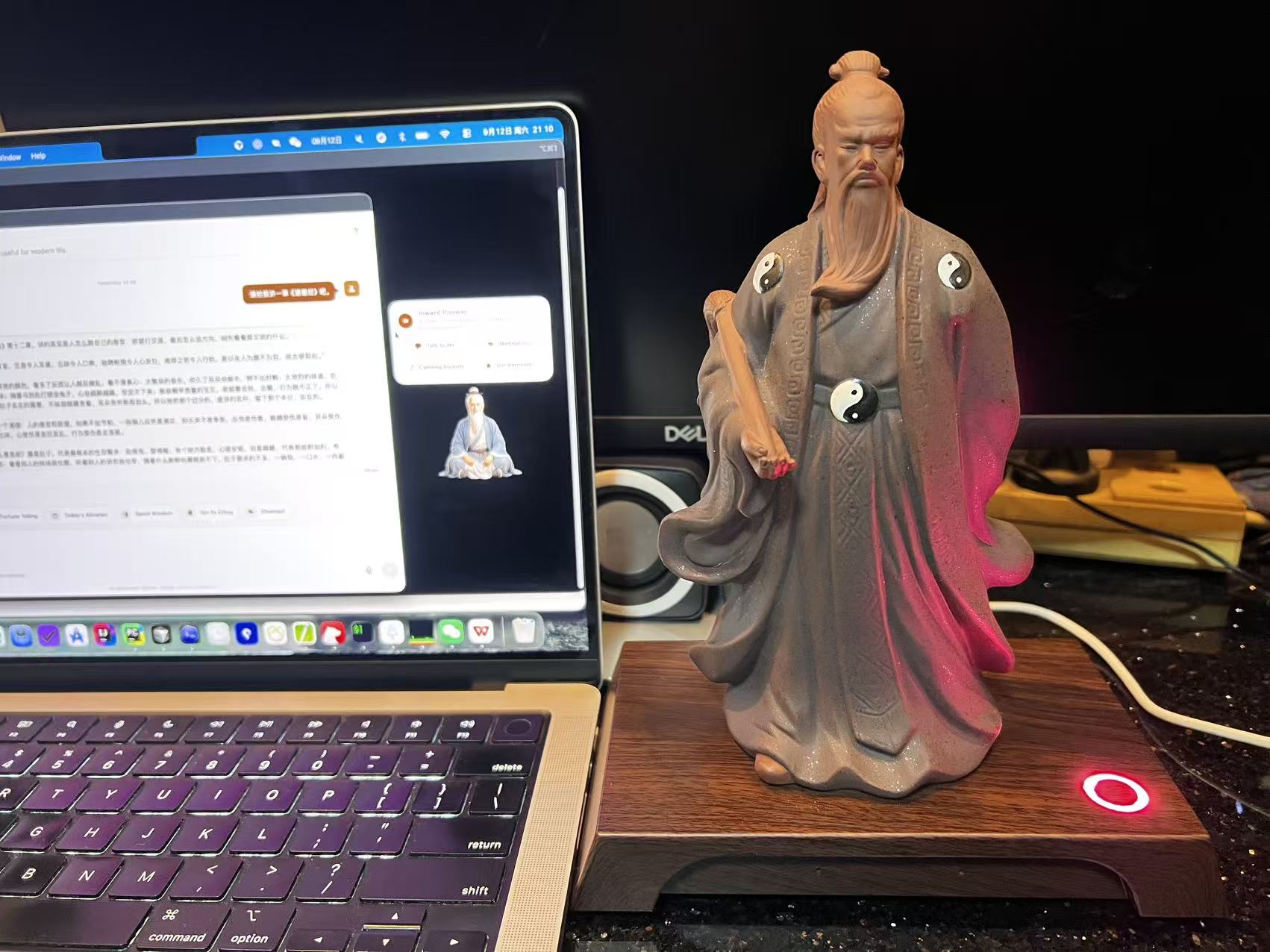
So we created the first product in the Zen Echo line: a Wang Yangming AI figurine.
The idea was simple.
We wanted it to feel like having Wang Yangming as a friend.
When someone was confused, they could talk with him, look at the situation from another angle, and leave with a small suggestion they could actually act on.
Later we created a Zhang Sanfeng figurine around Taoist ideas and continued experimenting with other forms of Eastern philosophy.
Through these products, we gradually realized something.
Many people already have access to a great deal of knowledge.
The difficult part comes when something actually happens to them.
At that moment, having someone who genuinely understands a philosophy, listens to the whole situation, and helps untangle it can sometimes be more useful than taking another course or reading another book.
Wang Yangming helped me recover my judgment. Taoism taught me how to live with the world around me.
Later, I began reading the Tao Te Ching more systematically.
Today, we mainly use the commonly circulated Wang Bi edition of the Tao Te Ching as the primary classical text behind our Taoist content.
When I first started reading it, I did not follow one specific modern commentator.
I read the original text, looked up different modern explanations, and gradually built my own understanding.
The idea that affected me most was “the Tao follows what is natural” — dao fa ziran.
Wang Yangming's philosophy had already helped me in one important way.
It helped me bring my own judgment back.
I used to care too much about how other people evaluated me.
If my manager said my management was poor, I immediately doubted myself.
If someone rejected my technical proposal, I felt a strong need to prove that I was right.
Wang Yangming's philosophy helped me understand that I first needed to know what I believed was right, act on it, and then continue testing that judgment through what actually happened.
That solved a large part of my problem.
But later I realized that having your own judgment does not solve everything.
It can create another problem.
You may know what you think is right, and then start believing that everything around you should follow that judgment.
You think a project should move in a certain direction, so you want reality to cooperate.
You think someone has misunderstood you, so you want to explain until they finally agree.
You think a team member is doing something the wrong way, so you want to step in and correct it.
After starting a company, this tendency became much more obvious in me.
If an employee did not reply quickly, I would wonder whether they were being lazy.
If a task was delayed, I would start questioning their execution.
If a co-founder moved more slowly than I expected, I would wonder whether they were really committed.
When the company went through a difficult period, I would keep projecting further into the future.
What if we do not get results this month?
What if we run into cash flow problems?
What if the product does not sell?
What if the company fails?
And what happens after that?
Many of these things had not happened at all.
I had already lived through them repeatedly in my head.
I wanted to control everything.
If employees worked the way I expected, my co-founder moved according to my plan, the product developed the way I imagined, and every part of the company stayed under control, then perhaps the company would arrive at the outcome I wanted.
Reality does not work that way.
You cannot fully control another person.
You cannot control the market.
You certainly cannot control a future that has not happened.
As I spent more time with Taoist ideas, I slowly began to understand why concepts such as naturalness, non-forcing, and non-contention matter.
They helped me in a different way from Wang Yangming.
Wang Yangming helped me ask:
What should I use to judge myself?
Taoism made me ask another question:
Even if I have my own judgment, do I really need everything around me to follow it?
That question changed a lot for me.
In the past, when someone rejected my view, I often wanted to prove them wrong.
Later I started asking something simpler.
Is there anything useful in what they are saying?
If there is, I can accept it.
If there is not, I do not need to argue until they finally admit that I was right.
The outcome of the work will eventually tell us something.
The same thing happened in management.
I used to see something moving differently from my expectations and immediately want to intervene.
Later, I began forcing myself to wait for a moment.
Has something actually gone wrong?
Or do I simply dislike the way it is unfolding?
Does this situation need me right now?
Or is the team still working through it?
Does this decision really need to be made today?
Would we know more if we waited two days?
Reading the Tao Te Ching did not suddenly make me calm about everything.
When someone failed to reply, I still got annoyed.
When a project moved slowly, I still asked too many questions sometimes.
When the pressure of entrepreneurship became heavy, I still lay awake thinking about whether the company would survive.
The difference was that I slowly became better at catching myself just before I rushed in and tried to control everything.
Sometimes I waited an hour or two, and the problem resolved itself.
Sometimes I really did need to step in, so I handled it.
Sometimes I thought about the situation and realized there was actually nothing useful I could do at that moment.
Then I returned to the work in front of me.
That change helped me a lot.
I used to spend a great deal of attention on one question:
Will this eventually become what I want it to become?
Later, I started asking more often:
What can I actually do right now?
The rest could stay unresolved for a while.
This is also how I now understand “following what is natural.”
It does not mean lying down and doing nothing.
When something needs to be done, you still do it.
You simply carry less of the urge to hold every part of reality in your hands.
That is one of the main reasons Taoist thought gradually became so important to me.
From Zen Echo to The Inward Pioneer
After people had used our Zen Echo hardware for some time, we ran into a very practical problem.
These devices usually sit in a study, tea room, or somewhere at home.
But many of the moments when people actually need help happen during the working day.
You leave a meeting feeling terrible.
You have a conflict with a colleague.
A project suddenly goes wrong.
You need to make a decision and cannot get your head straight.
At those moments, people usually want to talk to someone immediately.
Very few people will wait until they get home and then remember to ask the device sitting on their desk.
So we began thinking about a desktop application that could stay on the computer.
When something happened during work, you could click it and start talking.
In the earliest version, we placed several philosophical characters inside the application.
Users could choose which one they wanted to talk to.
That quickly created another problem.
People asked:
Who should I talk to about this?
What exactly is the difference between these characters?
When should I talk to Wang Yangming?
When should I use the Taoist character?
We realized that people were having to learn how our product worked before they could actually use it.
So we kept simplifying.
After several rounds of discussion and real-world use, we chose Taoism as the main philosophical core of The Inward Pioneer.
This was a practical product decision.
Wang Yangming's philosophy has had a deep influence on me personally, but many of its concepts require some background to understand.
Terms such as “the mind is principle,” “extending innate knowing,” and “refining oneself through affairs” can take time to understand.
That becomes even harder when building a product intended for people from different countries and cultural backgrounds.
Many Taoist questions connect more directly with ordinary life.
Everyone faces things they cannot control.
Everyone deals with gain and loss.
Everyone wants things they cannot always get.
Everyone encounters people who see the world differently.
And everyone has moments when they need to decide whether to push harder or stop for a while.
These experiences exist across cultures.
Taoist ideas can also lead naturally into concrete action.
They can help someone settle down enough to see a situation clearly, and then continue toward the question of what to do next.
Over time, The Inward Pioneer became what it is today:
a Taoist friend who lives on your desktop.
Where the Taoist knowledge in The Inward Pioneer comes from
The Inward Pioneer was not built by feeding an AI a handful of words such as “wu wei,” “non-contention,” and “follow nature.”
We first read the Tao Te Ching itself, alongside different modern explanations and other material on Taoist thought.
From there, the team gradually organized a body of domain knowledge that could be used in the product.
Today, we think about this material in three layers.
The first layer is the classical text.
Our main reference is the commonly circulated Wang Bi edition of the Tao Te Ching.
When the product quotes a classical passage, we want to be able to verify the wording, chapter, and source.
We try to avoid quoting from memory or presenting a modern saying as if it came directly from Laozi.
The second layer is interpretation.
Ancient texts are far removed from modern daily life, and the same passage can have more than one interpretation.
We use modern explanations to help understand the text.
When a passage has clearly different interpretations, we try to avoid presenting one reading as the only possible answer.
The third layer is the product itself.
At this point, we ask a different question:
How might this way of thinking help a real person look at a problem they are facing today?
For example, when the Tao Te Ching speaks about following what is natural, The Inward Pioneer may use that idea to discuss a person's urge to control a team, an outcome, or a future that has not happened yet.
That is a modern product interpretation.
We want to keep the original text, our understanding of it, and our modern application clearly separated.
How we turn a general-purpose AI into someone who understands Taoism
The large language model underneath the product has broad knowledge.
The Inward Pioneer deliberately narrows the way that knowledge is used.
We want it to have a stable knowledge boundary, a consistent way of looking at problems, and a recognizable way of speaking.
Our team combines the Taoist domain knowledge we have organized with character design, prompts, product rules, and response algorithms.
The goal is to make The Inward Pioneer approach real situations from the perspective of someone who understands Taoist thought deeply.
We are still refining this process.
We also do not want The Inward Pioneer to know how to do everything.
If a product can discuss the Tao Te Ching with you and, one minute later, recommend stocks, analyze a sports game, find a hotel, and write code, it starts to feel like a general-purpose tool again.
The Inward Pioneer keeps a narrower role.
It mainly deals with a person's situation, choices, relationships, gain and loss, control, action, and how Taoist ways of thinking might help with those situations.
How we decide whether an answer is useful
The Inward Pioneer does not yet have a fully formalized philosophical content review system.
Today, the main method is continuous human testing by the founding team.
We rarely create polished, imaginary questions purely for testing.
Most of the time, we use things that are actually happening to us.
If we are struggling with entrepreneurship, we ask about that.
If there is a management conflict, we give the real situation to The Inward Pioneer.
If something happens in family life and we do not know how to handle it, we test that too.
Then we judge whether the answer helps us.
We mainly look at a few things:
- Did it actually understand the problem, or did it simply repeat familiar advice?
- Did it help the person step outside the immediate emotion or point of view?
- Did it offer one or two actions that can realistically be taken?
- Did it say too much simply to appear knowledgeable?
- After reading the answer, would we ourselves be willing to try what it suggested?
If an answer gives us a long list of ideas and still leaves us searching through the response to figure out what to do, we usually keep working on it.
We want The Inward Pioneer to say less.
We want it to get to the important part.
Then it should leave the person with enough clarity to take the next step.
Three real situations
1. During the hardest period of starting a company, I wanted to control everything
At one point during the most difficult stage of the company, I spent every day thinking about things that had not happened yet.
Why has this employee not replied?
Why is this project still unfinished?
Why is my co-founder moving so slowly?
What if the company fails?
What happens after it fails?
Some of these questions came from real pressure.
But I kept extending them further and further into the future until my mind was full of problems I had created myself.
I began talking about these situations with early versions of The Inward Pioneer and also went back to the Tao Te Ching.
Slowly, I started accepting something.
Some things really did need me to push them forward.
Some things needed to be completed by the team.
And many future problems did not even have enough information yet for anyone to make a useful decision.
I had been mixing all three together and treating them all as problems that had to be solved immediately.
Later, I started separating them.
What problem actually exists today?
What can I actually do today?
Everything else can wait.
This did not suddenly make me stop worrying.
When the pressure of the company became heavy, I still felt anxious.
I still thought about too many possibilities.
The difference was that I became less likely to disappear into problems that had not happened.
Sometimes I finished the one thing in front of me, woke up the next day, and discovered that something I had worried about yesterday no longer existed.
2. In management, leaving room for other people
A friend of mine also manages a team.
He often doubted the ability and execution of the people around him.
As a result, he watched many tasks closely and wanted to define exactly how things should be done.
We used The Inward Pioneer to discuss this problem together.
One useful direction came from the Taoist idea of wu wei.
In a modern management context, we experimented with a simple interpretation:
Set the goal, rules, and boundaries clearly, then leave room for the team to do the work.
Step in at important points.
If every step is decided by the manager, something strange can happen.
The manager becomes exhausted, while the team feels that it is simply following instructions.
If things go well, everyone says the manager designed it.
If things go badly, they can also say they were simply doing what the manager asked.
The team has little room to develop its own judgment.
The Tao Te Ching also contains lines such as “when the work is accomplished, he does not dwell on it” and the image of “the highest good” being like water.
We use those ideas to discuss very practical management questions.
Does the manager always need to stand at the front after something succeeds?
Does every team need constant ranking, comparison, titles, and internal competition?
Some things that appear motivating can also make people increasingly focused on winning against one another.
These are modern applications of Taoist ideas in real management situations.
My friend later tried some of these approaches with his team and also began using the product himself for everyday problems.
3. With children, I also learned to control less
While revisiting the Tao Te Ching through The Inward Pioneer, I also began thinking differently about how I interact with children.
There is a line in the text:
Can you concentrate your breath and reach softness, like an infant?
Another says:
Giving birth without possessing, acting without relying on it, guiding without ruling.
These passages made me think about something very ordinary.
As a parent, it is easy to think:
I know what is good for you, so you should listen to me.
That can quickly turn into two people pushing against each other.
Children need care.
They need rules.
They also eventually need to grow into themselves.
A parent can share experience, point out risks, and set some boundaries at home.
Some things still need to be discovered by the child.
I still get angry when a child refuses to listen.
I certainly do not manage every situation patiently.
But sometimes, just before I react, I now ask myself:
Is this really that serious?
Am I teaching something important here?
Or do I simply want the child to do things my way?
That question has had practical value in my own family life.
It has also made me more certain that the kinds of situations The Inward Pioneer can discuss are very concrete.
Work, management, family, relationships, and decisions often share a similar problem:
When we are trapped inside a situation, it becomes difficult to see what is actually pushing us.
Why we call it a “friend”
Inside the team, we often describe The Inward Pioneer as a Taoist friend.
My own idea of friendship is close to the Chinese idea of junzi zhi jiao — a friendship that does not depend on constant closeness.
A real friend does not need to be beside you all day.
You do not need to talk every day.
But when something genuinely matters and you ask for help, they take your problem seriously.
They listen carefully.
They think about it.
They use what they know to help carry the problem with you.
There is a very ordinary phrase I like:
Someone who helps you carry the weight when something happens.
Imagine you say:
“My boss is an idiot. Should I quit right now?”
The Inward Pioneer will not agree immediately just to make you feel supported.
It will not make the decision for you either.
It should help you step slightly outside the situation.
Is the real problem this particular boss?
Or is it the way the organization is managed?
Is this anger coming from one bad conflict today?
Or has the problem been going on for a long time?
If this argument had not happened today, were you already thinking about leaving?
What is worth checking before you resign?
Once a person gets a little distance from the situation, they often already know what they need to do.
The Inward Pioneer has boundaries
We do not want it to make major life decisions for users.
It should not tell someone, “You must quit,” “You must get divorced,” or “You must make this investment.”
We do not position The Inward Pioneer as a therapist or psychological treatment product.
Ideas such as wu wei and non-contention should never become an excuse to tell someone to simply endure everything.
A single line from the Tao Te Ching should not be forced onto every problem.
When we quote a classical text, we try to verify the wording and source.
When we are uncertain, the product should not invent what Laozi supposedly said.
We also do not want The Inward Pioneer to agree with users simply because agreement feels supportive.
A good friend sometimes needs to say:
There may be another way to look at this.
Where our content review process stands today
We want to be transparent about this part.
Today, content review for The Inward Pioneer still relies mainly on human testing and continuous iteration by the founding team.
We have a body of Taoist domain knowledge, product rules, prompts, and response algorithms.
We have not yet turned all of our judgment criteria into a fully formalized review process.
That is something we are continuing to build.
One part of the work is improving our source system.
We will continue using the commonly circulated Wang Bi edition of the Tao Te Ching as our main classical text, while gradually establishing a fixed set of modern commentaries and research materials that we reference over time.
Another part is turning the judgments we currently make through experience into clearer rules.
For example:
Is a classical quotation accurate?
Does the answer make an overly strong claim?
Is it making a decision for the user?
Is the answer too long?
Does the advice actually lead to something a person can do?
In the future, we also plan to use AI to help with this review layer.
AI can help detect obvious problems.
The team will still be responsible for deciding the rules, the boundaries of the product, and what kinds of answers we consider acceptable.
We hope that, over time, you need The Inward Pioneer less
One of the biggest problems during the difficult period of my previous career was that I had handed the power to judge myself over to other people.
If they approved of me, I felt I was doing well.
If they rejected me, I immediately doubted myself.
If The Inward Pioneer eventually became another voice that users depended on to judge everything in their lives, the product would have moved in a direction we do not want.
We hope that after enough conversations, people become better at separating a few things.
What is actually happening.
What is only a fear they have imagined.
What can be acted on.
What cannot be controlled yet.
What they genuinely want.
What they are doing only because they are afraid of how someone else will judge them.
Then they can make their own decision again.
The Inward Pioneer can help you see the situation more clearly when you need it.
It can help you find one or two things you can do next.
The life that follows still belongs to you.
A real friend should also know when to step back.